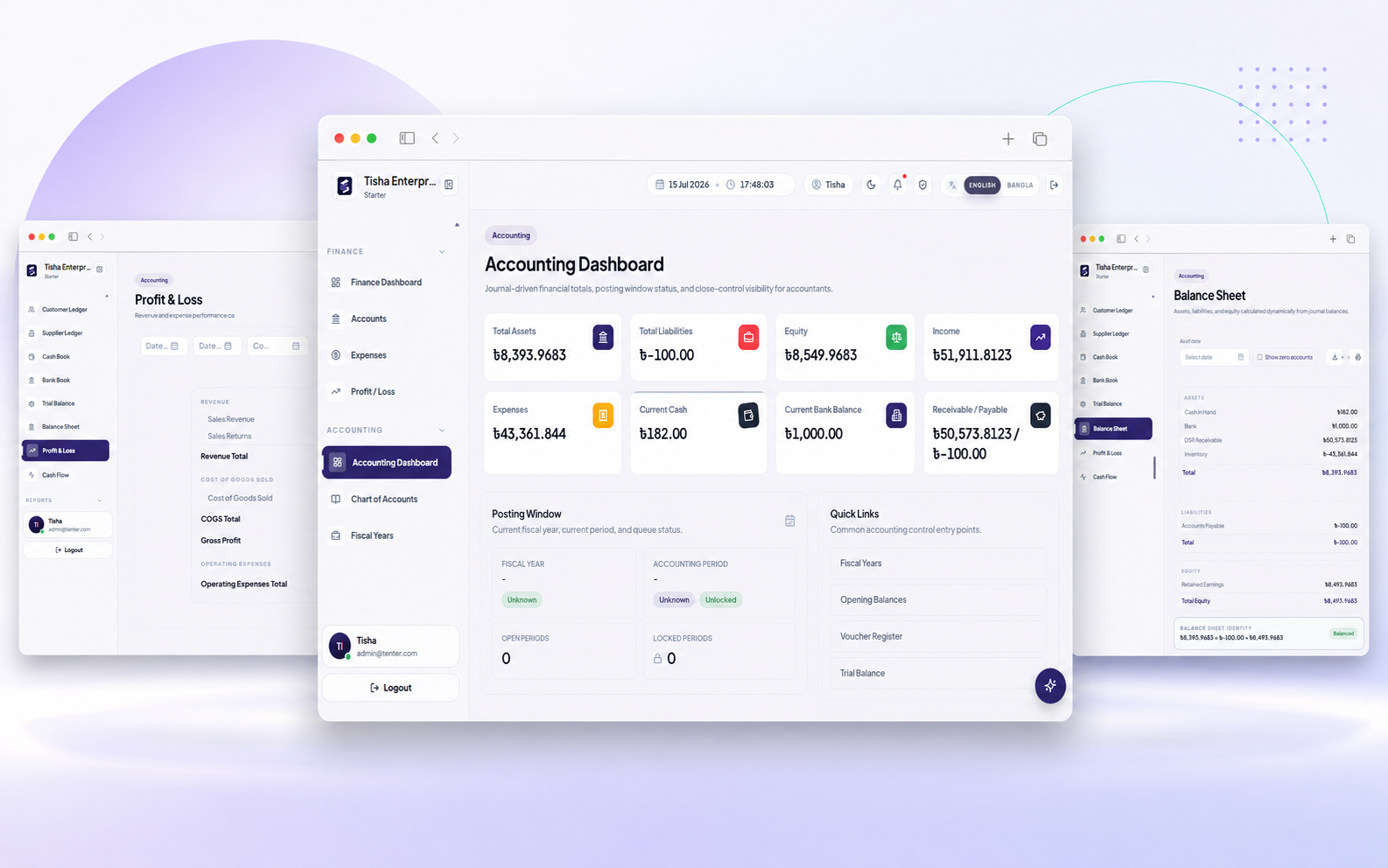
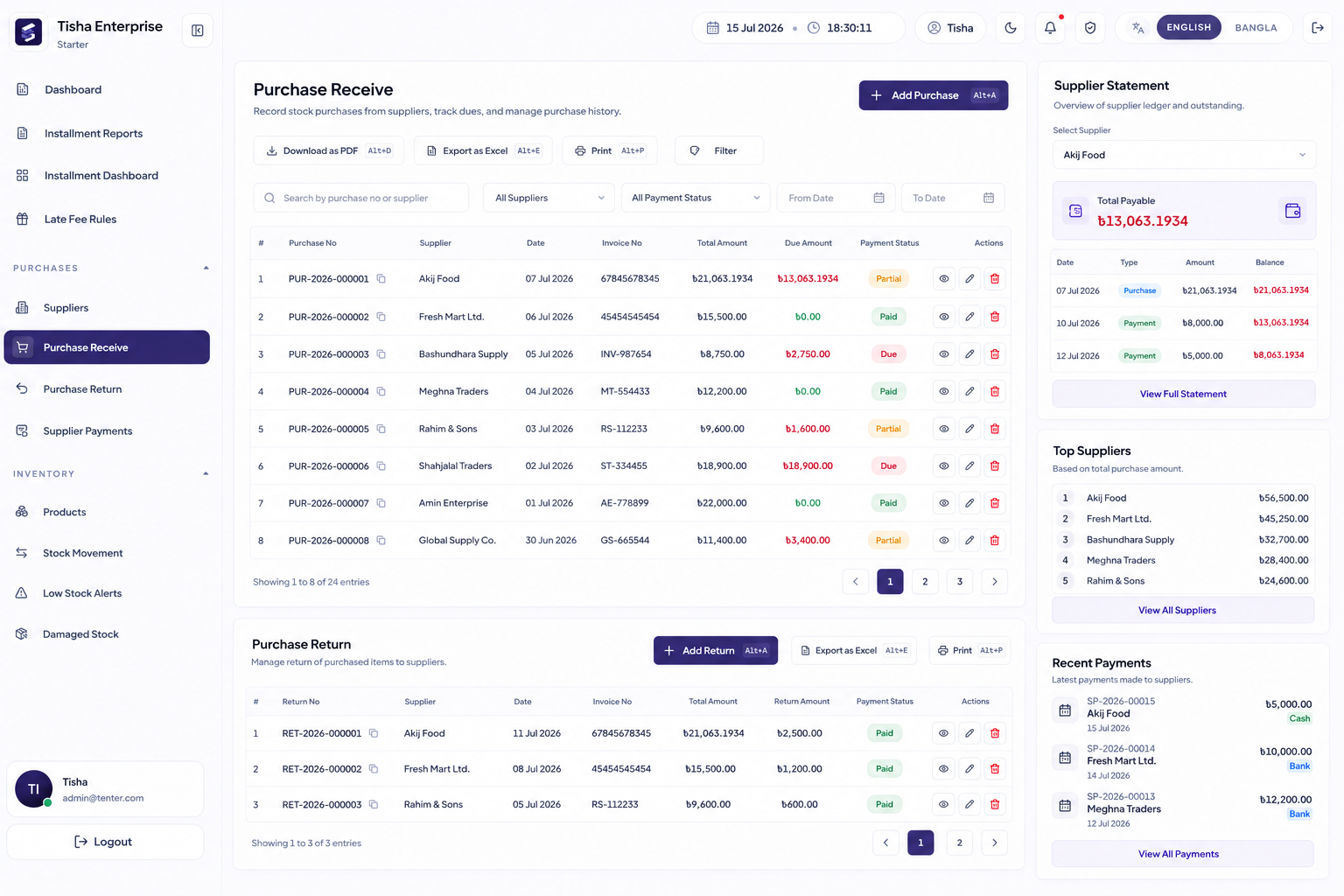
StockLedger does not stop at sales and stock. It includes finance accounts, expenses, vouchers, journal registers, ledgers, cash book, bank book, trial balance, balance sheet, profit and loss, and cash flow reporting.
StockLedger workflow
Less duplicate entry
Sales, purchases, returns, payments, due collection, settlements, and expenses become part of one financial picture, reducing the need to re-enter the same business events in separate tools.
StockLedger workflow
Owner and accountant can work from the same truth
Business owners can monitor cash, dues, stock value, and profit while accountants can review ledgers and statements from structured records.
StockLedger workflow
Accounting software should reduce reporting delay
Many businesses search for accounting software because month-end clarity arrives too late. The practical value is not just ledger creation. It is faster review of receivables, payables, expenses, cash, bank movement, and profitability from the same records the business uses daily.
StockLedger workflow
Built for businesses that have already outgrown manual summaries
In growing shops, wholesale businesses, dealer networks, and mixed operations, accounting often becomes the bottleneck because sales and finance live in separate systems. StockLedger is stronger where operations and accounting need to stay synchronized.
Buying guide
Why businesses search for this type of software
Buyers usually land on this page when the current workflow has become too manual, too slow, or too disconnected from daily reporting. They are not just looking for a feature list. They want to know whether Accounting can stay connected with sales, stock, due, purchasing, finance, user control, and management reporting.
That is where StockLedger is different from a narrow single-purpose tool. It is designed for businesses that want one operational system instead of separate apps that have to be reconciled later. For many teams in Bangladesh, that means fewer duplicate entries, better owner visibility, and cleaner day-end or month-end review.
Expected outcomes
What usually improves after implementation
Faster month-end and day-end visibility for cash, bank, expenses, and receivables.
Cleaner handoff between owner, manager, cashier, and accountant.
Better confidence in ledger, trial balance, profit and loss, and balance sheet review.
Connected modules
What businesses usually connect next
The strongest SEO pages are also the clearest buying pages. A company that needs Accounting rarely needs it in isolation. Most teams also ask about reporting, finance visibility, stock accuracy, collection control, role permissions, or route accountability.